
Billing basics
Why superbills get rejected — 9 fixable reasons
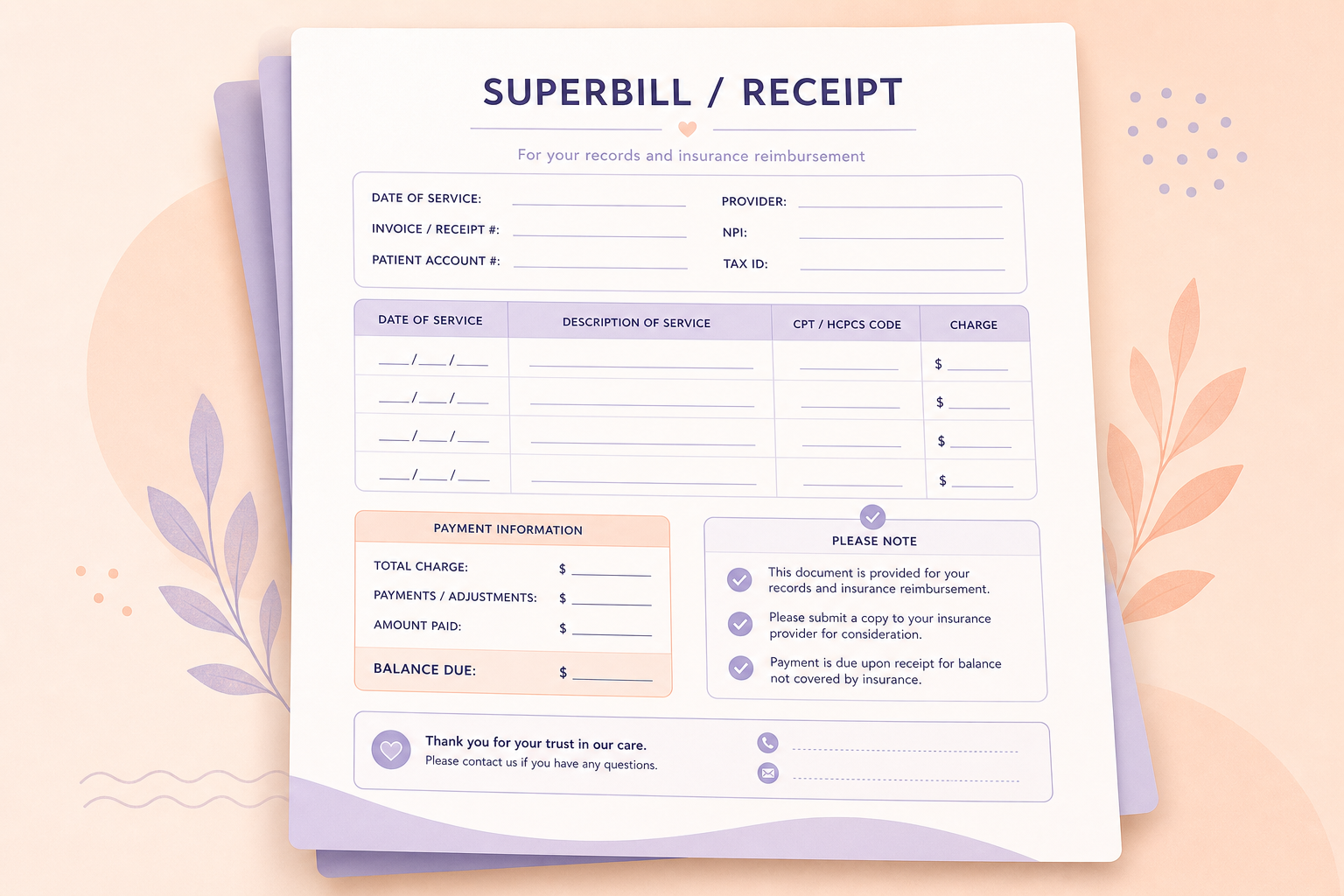
Most superbill rejections trace back to a handful of missing or mismatched fields. Fix these nine and your families' claims sail through.
Step 1
Missing NPI
Both rendering and billing NPIs matter. No NPI is the single most common bounce for homemade Word-doc superbills.
Step 2
Missing tax ID (TIN/EIN)
Payers match charges to the practice via tax ID. Include the EIN your practice bills under.
Step 3
No ICD-10 diagnosis
A CPT code without a supporting diagnosis is unpayable. Every superbill needs at least one ICD-10 code.
Step 4
Vague service descriptions instead of CPT codes
“Speech session — $150” is a receipt, not a superbill. Each line needs a real CPT code.
Step 5
Missing place of service
Office vs home vs telehealth changes adjudication. Include the POS code per line.
Step 6
Date ranges instead of per-visit lines
“March: 8 sessions — $1,200” gets rejected. Itemize each date of service with its own code, units, and fee.
Step 7
Provider credentials absent
License/credential (MS CCC-SLP, OTR/L, PT DPT, BCBA) ties the service to a qualified provider.
Step 8
Units missing on timed codes
Timed codes like 97110 and 97153 need units per line; untimed codes like 92507 are one per session.
Step 9
Math that doesn't add up
Line fees must sum to the total, and the total should match proof of payment. Administrators reject on mismatches.
A generator that enforces these fields beats a template that lets you forget them — that's exactly why the free Therativities superbill tool includes NPI, TIN, POS, ICD-10, per-line CPT with units, and totals that reconcile.
FAQ
Do payers ever require their own claim form on top of the superbill?
Yes — many want a member reimbursement form attached to the superbill. Families should download it from the payer portal and staple the two together.
What should a family do after a rejection?
Read the EOB reason code, fix the missing element, and resubmit within the timely filing window. Most first rejections are correctable paperwork issues, not benefit denials.
More practice guides
Educational content only — not billing, legal, or tax advice. Verify payer policies and regulations for your state and situation.